

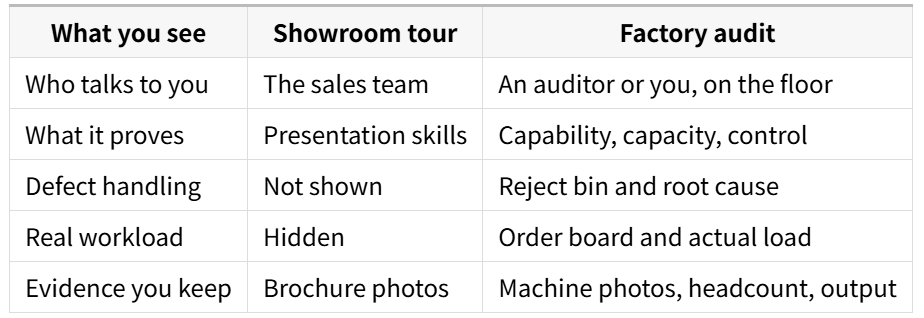
Buyers often judge a supplier by the showroom. The samples are perfect, the brochure is glossy, and the meeting room has good coffee. None of that tells you what happens on the production floor when your order is one of fifty running that week. A factory audit does.
If you source from China, the visit you are offered is usually a showroom tour. The audit is the part most suppliers would rather skip. That is exactly why it matters. Our full supplier verification guide walks through the document checks first; this article focuses on the floor visit itself, and why it beats any presentation.
What a factory audit actually checks
The production floor tells the truth
Ask to see the reject bin
Check the real order board
Document everything
You can audit without flying to China
What a good audit report contains
The cost of skipping it
Make it repeatable
FAQ
A proper audit looks at three things: capability, capacity, and control.
Capability means the machines and skills to make your product to spec.
Capacity means they can deliver your volume on time without overloading the floor.
Control means they catch defects before shipping, not after you complain.
A showroom shows none of these. An audit measures all three. Most structured audits also cover legal status, quality system, equipment, materials, personnel, and social compliance, which is how you separate a real manufacturer from a trading company. See our piece on avoiding Chinese factory scams for the red flags that show up on paper first.
Walk the line and watch how workers handle materials. Are components labeled and sorted, or piled in a corner? Is there a clear in-process check, or does finished goods go straight into a carton? Small things like a missing QC station show up later as a container of rejects. A clean, labeled floor is not decoration. It is a signal that the plant runs on systems, not memory.
One fast check: cross-check the business license, the factory sign, the employee badge, and the bank account name. All four should match. Any mismatch is a strong sign you are talking to a trading company, not the factory making your goods.
A factory with zero defects is lying or not checking. A good factory keeps a separate area for failed items and can tell you why each one failed. That honesty is worth more than a perfect pitch, because the same process that caught their problem catches yours.
Ask what else is in production this week. If the plant is running three times its comfortable load, your lead time is at risk no matter what the salesperson promised. Capacity honesty protects your timeline more than any discount. A factory that admits it is full until next month is more valuable than one that promises everything and delivers late.
Take photos of the machines, the QC area, and the raw material storage. Note the license, the worker count, and the actual output per day. A year from now, when you reorder, this record tells you whether the factory grew or just got better at talking. It also gives you leverage: a supplier who knows you documented the floor is less likely to quietly change the process.
You do not need to travel. A local inspector or sourcing partner can run the same checklist and send photos, videos, and a written report. A remote audit typically runs $200 to $400, and a full third-party on-site audit runs about $300 to $800. Either way the cost is a fraction of a failed order, and it removes the showroom filter entirely. For a first order, a remote audit is the single highest-return step you can take.
A useful report is not a grade, it is evidence: machine photos with model numbers, a headcount, daily output, the QC station layout, and the rejected goods area. With these, you can compare two factories on facts, not pitch decks. A plant that makes 500 units a day and runs a real in-process check is a different bet than one claiming 2,000 with no QC station, even if both quote the same price.
A remote audit typically runs a few hundred dollars. A failed first order from an unverified factory can cost the entire deposit plus rework and a missed season. On a $30,000 order, the audit is about 1 percent of the risk it protects. Industry estimates put the share of B2B-platform "factories" that are actually trading companies at 30 to 50 percent, and physical verification removes roughly 40 percent of candidates. Buyers who audit before the deposit almost never face the "which factory am I really using" surprise at shipping time, because they already saw the floor.
Turn the audit into a one-page template you reuse for every supplier. Same checklist, same photo list, same scoring. Over a year this gives you a comparable record across all your factories, so you reorder from the ones that proved real and drop the ones that did not. Consistency is what turns a one-time check into a sourcing advantage, and the template also speeds up onboarding of new suppliers because the standard is already set.
It checks capability (machines and skills to make your product), capacity (can they hit your volume on time), and control (do they catch defects before shipping). Most audits also cover legal status, quality system, equipment, materials, personnel, and social compliance.
A remote audit typically runs $200 to $400. A full third-party on-site audit runs about $300 to $800 per man-day. Both cost far less than a failed order.
Yes. A local inspector or sourcing partner can run the same checklist and send photos, video, and a written report. For a first order, a remote audit is usually the best return on time and money.
An audit evaluates the supplier's ability to make your product (capability, capacity, control). An inspection checks whether a specific finished batch meets your spec. You need both, but the audit comes first, before you commit a deposit. Our pre-shipment inspection checklist covers the batch side.
Cross-check four things: the business license, the factory sign, the employee badge, and the bank account name. If any do not match, you are likely dealing with a trading company, not a manufacturer. A visit to the actual floor settles it.
Factories · Freight · Customs · Payment — all handled. Need help? Contact Linkyourfactory, your China supply-chain partner.
Copyright @ Link your factory
SitemapBack to top
This website uses cookies to ensure you get the best experience on our website.


Comment
(0)